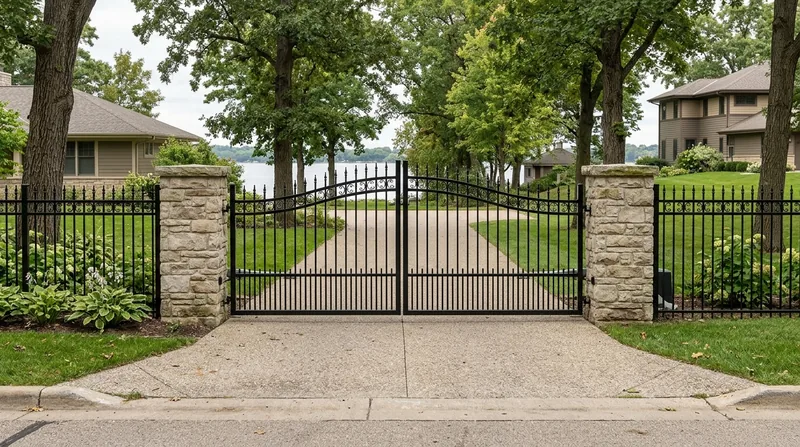




Madison sits on an isthmus between two lakes, and the freeze-thaw cycles that define winters here take a toll on fencing and gates. Spring snowmelt keeps soil wet, winter plows push snow against property lines, and the long cold season means gate tracks fill with ice and frost heaves posts out of the ground. A driveway gate installation in Madison has to account for these realities: tracks that shed slush, openers that work in sub-zero temperatures, and posts set deep enough to resist the heave that lifts everything else. Whether you need a sliding gate that clears plowed snow or a swing gate on solid ground, the opener and safety sensors have to be rated for Wisconsin winters. We install and repair automatic gates on properties across Madison, Middleton, Sun Prairie, and the surrounding towns, working with professional-grade openers from all major brands and keeping your gate working through the season.
Why Automatic Driveway Gates Matter in Madison's Climate
Madison's long winters and heavy spring thaw create specific challenges for gate operation. Snow accumulates against tracks, ice forms around hinges and sensors, and the constant cycle of freezing and thawing heaves posts and throws gate alignment out. A gate that works fine in September can bind solid by December if the opener and track layout do not account for snow load and frost. Professional installation means positioning tracks to shed plowed snow, choosing an opener rated for cold starts, and setting posts below the frost line in concrete so they stay put when the ground heaves.
- Snow and ice accumulation in tracks stops sliding gates unless the layout is planned to shed plowed snow from the driveway.
- Frost heave lifts posts out of the ground each spring, throwing gate alignment and putting stress on hinges, sensors and the opener itself.
- Cold-weather openers are rated to start and cycle in sub-zero temperatures, while summer-grade equipment can fail when it gets below freezing.
- Safety sensors and keypads need protection from salt spray and road salt that eats metal and corrodes electrical connections.
- Swing gates on solid ground work better than sliding gates on soft or wet soil, where frost heave is most aggressive.
Getting the gate right the first time means it runs reliably for years, not becoming a seasonal headache that stops working when you need it most.
Key info: Madison homeowners in neighborhoods like Maple Bluff, University Heights, and Shorewood Hills often face frost heave damage in spring because older properties have posts set shallow. A professional gate installation puts posts 4 feet deep, below the frost line, so your gate stays level and your opener does not have to fight heaved frames every season.
For more on how frost and seasonal changes affect your property, see our guide to fence post repair and replacement in Madison.
How We Install and Repair Automatic Gates in Madison
Installation starts with a site visit to understand your driveway slope, soil conditions, existing utility lines, and whether you want a swing or sliding gate. We call for a utility locate through Wisconsin 811 to mark buried lines before we dig any post holes. We then set posts in concrete below the frost line, install the gate frame and panels, mount the opener and safety sensors, and test everything in real conditions. Repair work follows the same logic: we diagnose what is not working, replace failed parts, and adjust alignment and sensor settings so the gate opens and closes smoothly.
- We schedule a free site visit to measure the driveway, check slope and soil, and discuss swing versus sliding options for your property.
- Wisconsin 811 utility locates are called before digging to mark gas, electric, water and sewer lines on your property.
- Posts are set 4 feet deep in concrete to resist frost heave and provide a solid anchor for the gate frame and opener.
- The gate frame is installed level and plumb, with hinges or track aligned so the gate swings or slides freely without binding.
- Professional-grade openers are mounted, wired to power or solar panels, and tested through multiple cycles in cold and warm weather.
- Safety sensors are positioned and calibrated to stop and reverse the gate if an obstruction is detected during opening or closing.
- Keypads, remotes, and emergency manual release are installed and tested so you can operate the gate from your vehicle or on foot.
Once the gate is installed and tested, we walk you through operation and maintenance so you know how to keep it working and when to call for service.
Example: A homeowner in Fitchburg with a long rural driveway chose a solar-powered sliding gate because no trenched electric line ran to the property. We set the posts in concrete 4 feet deep to anchor the track, installed a linear actuator opener with backup battery, and mounted a keypad at the gate and a wireless remote in the house. The gate now opens and closes year-round without utility bills, and the battery keeps it running through winter power outages.
For related gate work, visit our page on gate installation and repair in Madison.
Sliding versus Swing Driveway Gates: Which Works Best for Madison Properties
Sliding and swing gates solve different problems. A sliding gate rolls on a track parallel to the fence line, so it does not need clearance on either side of the driveway opening. A swing gate pivots on hinges at one side, like a standard gate, and needs open space for the gate to swing out. In Madison, the choice depends on driveway width, soil conditions, and how you want to manage snow.
| Approach | Description | Best for |
|---|---|---|
| Sliding Gate | Gate rolls on a track mounted above or below ground, moving parallel to the fence line. Requires a cantilever or V-track system to stay clear of snow and ice. Linear actuator or chain drive operator pushes or pulls the gate open and closed. | Narrow driveways, properties where swing clearance is blocked by trees or structures, and rural properties with long drives where the gate can retract fully without obstruction. |
| Swing Gate | Gate pivots on hinges mounted to a post at one side of the opening. Arm operator or hydraulic closer swings the gate open and closed. Simpler mechanics than sliding, fewer moving parts and less maintenance. | Residential driveways with enough clearance on one side, properties with solid soil and minimal frost heave, and situations where the driveway is wide enough to open the gate fully without hitting landscape or structures. |
| Cantilever Sliding | Track is mounted above the gate, with the gate hanging from rollers that ride the track. Post is set back from the opening, not at the gate line. Keeps the track high and clear of snow, ice and plowed debris. | Madison properties with heavy snow load, driveways where snow is pushed to the sides, and rural or estate properties where snow management is a priority. |
| V-Track Sliding | Track is mounted in a V-shaped channel at ground level, with the gate riding in the channel on self-cleaning rollers. Simpler than cantilever but track is lower and more exposed to ice and debris. | Residential driveways where snow management is routine, properties with moderate climate impact, and situations where the driveway width allows the gate to slide fully open without obstruction. |
Swing gates are simpler and cheaper to install, with fewer moving parts and less maintenance. Sliding gates need more planning but are better for tight spaces and heavy snow. In Madison, we often recommend swing gates for residential properties on stable ground, and sliding gates with cantilever track for rural properties where snow plow traffic is heavy or driveway width is tight.
Automatic & Driveway Gates Cost in Madison: What to Expect
A basic swing gate with a professional-grade opener starts at $2,800 and covers the gate frame, hinges, arm operator, keypad, and safety sensors. Sliding gates are more complex and typically run $3,500 to $5,000 or more, depending on track length, the need for cantilever mounting, and terrain. Solar-powered openers add $800 to $1,200 because they include a battery system and panel. Driveway width, soil conditions, frost depth, and existing utility lines all affect the final price. A long rural driveway with soft soil might cost more because posts need to go deeper or the track needs reinforcement. A short residential driveway on solid ground costs less.
We recommend getting 2 to 3 estimates so you can compare opener brands, gate materials, and installation approaches. The cheapest estimate is not always the best value if it cuts corners on post depth, opener quality, or sensor placement. A professional installation costs more upfront but saves you money in repairs and replacements down the road.
Cost factors: A swing gate on a standard residential driveway in Madison runs $2,800 to $3,500. A sliding gate on a long rural driveway with cantilever track and solar power can reach $5,000 to $6,500. Repair work like replacing an opener or fixing frost heave damage runs $400 to $1,200 depending on what has failed.
For a detailed breakdown of pricing for all our fence and gate services, visit our pricing page.
Automatic & Driveway Gates Near Me: What Madison Homeowners Should Know Before Hiring
Finding a contractor who understands Madison's climate and soil is more important than finding the cheapest estimate. Ask whether the contractor has installed gates in your neighborhood and how they handle frost heave and snow management. Check that the contractor carries general liability and workers' compensation insurance, and ask for a certificate of insurance before work starts. In Wisconsin, fence and gate licensing rules vary by county and project size, so verify with your local building department or HOA whether permits are required for your driveway gate. Many master-planned communities in Fitchburg, Verona, and Middleton have HOA architectural standards that govern gate height, material, and color, so check your deed restrictions before you order anything.
Ask the contractor how they plan to handle utilities. Wisconsin law requires a utility locate through 811 before digging, and the contractor should call this out as a standard step. Ask about post depth, frost line depth in your area, and whether the gate will be set in concrete or tamped soil. Ask how the opener is powered and whether it has battery backup for power outages. Ask about warranty on parts and labor, and what the maintenance schedule looks like. Get everything in writing so you know what you are paying for and when the work will be done.
Call us at (608) 471-7749 for a free estimate. We visit your property, discuss your options, and give you a clear price with no obligation to book. We can answer questions about permits, HOA rules, and whether your property needs special handling for frost heave or snow management.
Automatic & Driveway Gates in Madison: Pricing Guide
| Service | Price | Details |
|---|---|---|
| Swing Gate Installation | Starting at $2,800 | Includes gate frame, hinges, arm operator, keypad, safety sensors, and posts set in concrete below frost line |
| Sliding Gate Installation | Starting at $3,500 | Includes track system, rollers, linear actuator or chain drive operator, keypad, safety sensors, and cantilever or V-track mounting |
| Solar-Powered Gate Opener | Add $800 to $1,200 | Includes solar panel, battery backup system, and wireless controls for rural properties without trenched power service to the gate |
| Gate Repair or Operator Replacement | Starting at $400 | Covers diagnosis, parts replacement, alignment adjustment, and sensor recalibration for existing gates or failed openers |
| Travel and Estimate | Free | No charge for site visit, measurement, or written estimate; response within 24 hours in Madison and surrounding areas |
Indicative pricing, the exact cost depends on square footage, finish, and site access. Free personalized estimate within 24h at (608) 471-7749.


