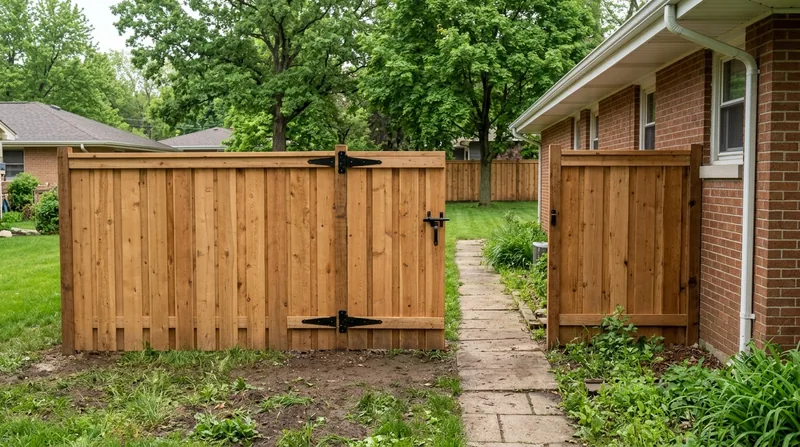




Gates are often the first part of a fence to fail in Madison. Frost heave from our deep winter freeze lifts posts out of the ground, spring thaw keeps soil wet and rots footings at the ground line, and heavy snow loads push panels and gates out of square. A gate that drags, binds, or sags is more than a nuisance: it signals that the post has shifted or the frame has racked, and ignoring it invites water into the wood and accelerates decay. Fence gate installation in Madison means building gates square, hanging them right with adjustable hinges, and bracing them against the frost heave and wind that dominate our climate. We rebuild gates that have failed after years of service, and we install new ones on new fence runs, with the same attention to post depth, concrete set, and hardware that keeps them working through the next ten winters.
Why Gate Repair and Installation Matter in Madison's Freeze-Thaw Cycle
Madison sits on the isthmus between two lakes in glacial country, and that geography means wet ground, deep frost, and a punishing freeze-thaw cycle every spring. Posts set shallow or in poor drainage heave upward as ice forms around them, lifting the gate frame and breaking hinges and latches. Once a post has moved, the gate binds against the frame, and the wood begins to absorb water from the binding surfaces. Within a season or two, rot takes hold at the ground line, and the post fails entirely. A gate installed with posts set below the frost line, in concrete, with proper drainage and anti-sag bracing, resists this cycle. A gate hung with adjustable hinges can be tweaked back into square even after minor frost heave, buying years of service before replacement becomes necessary.
- Posts set below the local frost depth (typically 42 inches in our area) and anchored in concrete resist heave and stay in place through winter.
- Adjustable hinges allow you to compensate for minor frame racking without removing the gate or replacing hardware.
- Anti-sag bracing, such as a diagonal cable or rod, holds a large gate square under its own weight and resists wind loads.
- Self-latching hardware keeps a gate closed without manual intervention, reducing the habit of leaving it open and the gate swinging into wind damage.
- Proper drainage around the post hole and a concrete collar that slopes away from the post prevent water from pooling and rotting the wood.
These details matter because gates fail fast once frost heave begins, and a repair made early costs far less than a full replacement.
Key info: Madison's frost line extends to 42 inches below grade, and posts must be set below that depth to resist winter heave. A gate installed at the standard 24 to 30 inches will shift every spring. We set posts to code depth and anchor them in concrete, which costs more upfront but eliminates frost heave as a failure mode.
For more detail on how frost heave affects fencing, see our guide to fence post repair and replacement.
How We Install and Repair Gates in Madison: A Step-by-Step Approach
Every gate begins with the posts. We locate the property line (or work from your existing survey), call 811 for a utility locate to avoid buried lines, and dig post holes below the frost line. Posts are set in concrete, not just tamped soil, and the concrete collar is sloped to shed water. We then build the gate frame square on sawhorses, using pressure-treated pine or cedar depending on your budget and aesthetic, and we install cross-bracing to prevent racking. Hinges are bolted through the frame, not just screwed, and we use self-closing self-latching hardware so the gate closes on its own. Finally, we hang the gate and adjust the hinges so it swings freely and latches without binding.
- Verify the property line and call 811 for a utility locate before any digging.
- Dig post holes to below the frost line (42 inches minimum in Madison) and set posts in concrete.
- Build the gate frame square on a flat surface, using kiln-dried lumber and stainless or galvanized fasteners.
- Install anti-sag bracing (diagonal cable, rod, or cross-brace) to hold the frame square under load.
- Bolt hinges through the frame and attach the gate to the posts with adjustable hardware.
- Hang and level the gate, then adjust hinges so it swings freely and latches without binding.
This process takes a full day for a standard wood gate, and two days if the post footings need to be dug and the posts left to cure in concrete overnight.
Example: A homeowner in Fitchburg had a 4-foot wood gate that sagged after two winters. The post had heaved slightly, and the frame had racked out of square. We dug the post deeper, reset it in concrete below the frost line, rebuilt the gate frame with diagonal bracing, and hung it with adjustable hinges. The gate now swings freely and latches tight, and it should hold for another decade without frost-related movement.
For information on our broader fence repair services, including panel and post work, visit our repair page.
Gate Installation and Repair Methods: Which Approach Works Best for Your Property
| Approach | Description | Best for |
|---|---|---|
| Wood gate rebuild | Disassemble the existing frame, replace any rotted boards, rebuild with new cross-bracing, and rehang with adjustable hinges. | Gates that sag or bind but whose posts are still sound, or when the frame is worth saving for appearance. |
| Post replacement with new gate | Remove the old gate and post, dig a new hole below frost line, set a new post in concrete, and build a new gate frame with anti-sag bracing. | Posts that have rotted at the ground line or heaved so severely that the gate cannot be salvaged by adjustment alone. |
| Vinyl gate installation | Build a vinyl gate frame with pressure-treated wood studs and vinyl boards, hung on aluminum or stainless hinges with self-closing hardware. | Properties where low maintenance and durability matter more than the look of natural wood, or in newer subdivisions where vinyl is the standard. |
| Cantilever or V-track gate | Hang the gate on a cantilever bracket or V-track so the weight is supported by the post without a bottom hinge, eliminating ground-level wear. | Driveways where snow plowing or heavy foot traffic would damage a bottom hinge, or where a gate must clear an uneven or sloping grade. |
| Automatic or electric gate operator | Install a linear or swing gate operator with a remote control, keypad, or smartphone app, plus safety sensors and a backup battery. | Driveway gates, pool gates, or any gate where convenience, security, or accessibility (for elderly or disabled homeowners) is the priority. |
Each method has a different cost and maintenance profile. Wood gates are attractive and fit most Madison neighborhoods, but they require staining or sealing every few years. Vinyl gates are durable and low-maintenance but are more common in newer subdivisions. Cantilever gates are ideal for snowy driveways. Automatic gates add convenience and security but require electrical work and regular maintenance of the operator. We can discuss which approach makes sense for your property and budget during a free estimate.
Gate Installation and Repair Cost in Madison: What to Expect
Gate work in Madison ranges widely depending on what you need. A simple repair to adjust hinges or tighten hardware on an existing gate may cost a few hundred dollars. A full wood gate installation, with posts set below frost line in concrete and anti-sag bracing, typically starts at $475 for a basic 4-foot single gate and moves upward based on width, height, material, and site conditions. A double driveway gate, a vinyl gate, or an automatic gate operator will cost more. The key factors that affect price are gate width (wider gates need heavier framing and more anti-sag bracing), material (wood, vinyl, or ornamental metal), post condition (if the existing posts are sound, a repair costs less than a full replacement), site access (if we must carry materials a long distance or work in tight quarters, labor increases), and whether the job includes an automatic operator.
Getting two or three estimates is smart. Each contractor will assess the posts, frame, hinges, and site conditions differently, and their pricing will reflect their material choices and labor rates. When you call for an estimate, be ready to describe the gate width, the material you prefer, and whether the existing posts seem solid or if you suspect frost heave or rot. For a detailed pricing breakdown and to discuss your specific situation, visit our pricing page or call (608) 471-7749 for a free estimate.
What to Look for When Hiring a Fence Gate Contractor Near Me in Madison
Finding the right contractor for gate installation or repair near Madison comes down to a few concrete checks. First, confirm that the contractor is fully insured with general liability and workers' compensation coverage, and ask for a certificate of insurance. Second, understand how fence licensing works in Wisconsin: fence work is not uniformly licensed across the state, and permitting rules vary by city and county. Madison, Fitchburg, Sun Prairie, Verona, and other communities in Dane County each have their own codes, so check with your local building department or HOA before work begins. Third, ask for references from recent gate jobs in your neighborhood, and call at least two to ask how the gate has held up and whether the contractor showed up on time and cleaned up after the work. Fourth, if your property is in an HOA or has deed restrictions, verify that the gate material, color, and height are approved before you sign a contract. Finally, get the estimate in writing, including the material list, post depth, and hardware specifications, so you know exactly what you are paying for.
- Verify that the contractor is fully insured and can provide a certificate of insurance on request.
- Call your local building department or HOA to confirm gate height, material, and setback rules before scheduling work.
- Ask for at least two references from recent gate installations in Madison or nearby communities, and call them.
- Request a written estimate that lists the gate dimensions, material, post depth, hinges, hardware, and total cost.
- Confirm that the contractor will call 811 for a utility locate before digging any post holes.
- Ask whether the contractor guarantees the gate to swing freely and latch properly at completion, and what the warranty covers.
A local contractor who has worked in Madison for years knows our frost line, our soil conditions, and the common failure modes of gates in our climate. That knowledge is worth paying for, because a gate installed to suit our weather will outlast a gate installed to generic standards.
Ready to move forward? Contact us for a free estimate at (608) 471-7749, with no obligation to book.
Gate Installation & Repair in Madison: Pricing Guide
| Service | Price | Details |
|---|---|---|
| Wood gate repair or adjustment | Starting at $475 | Hinge adjustment, latch repair, or minor frame tightening on an existing gate that is structurally sound. |
| Wood gate installation (single, 4-foot) | Starting at $875 | Posts set below frost line in concrete, gate frame built with anti-sag bracing, adjustable hinges and self-latching hardware included. |
| Double driveway gate or vinyl gate | Starting at $1,600 | Wider span, heavier framing, vinyl material, or ornamental hardware increases cost; automatic operator adds $1,200 to $2,500. |
| Post replacement with new gate | On estimate | Requires removal of old gate and post, new hole dug below frost line, concrete set, and new frame built; site access and soil conditions affect price. |
| Travel | Included | No mileage fee for Madison and surrounding areas including Middleton, Fitchburg, Sun Prairie, Verona, Monona, and Waunakee. |
| Free estimate | Free | Response within 24 hours at (608) 471-7749; no obligation to book, and the estimate includes a written quote with material and labor breakdown. |
Indicative pricing, the exact cost depends on square footage, finish, and site access. Free personalized estimate within 24h at (608) 471-7749.


